Quick answer
Fake IPTV reviews are easy to spot once you look at the pattern rather than the score: bursts of five-star ratings on the same days, vague praise with no device or problem, brand-new reviewer profiles, copied wording and ranking sites that link to one seller. Since April 2025 they have been unlawful in the UK under the DMCC Act.
Key takeaways
- Look at the pattern, not the score: timing, wording and reviewer history give fakes away.
- Real reviews mention details: the device, the problem, how support handled it.
- Fake and hidden incentivised reviews have been illegal in the UK since April 2025.
- Reviews can shortlist a provider, but only your own test can confirm one.
Why are fake IPTV reviews everywhere?
Because buyers cannot see the product before they pay. When you buy a kettle, you can pick it up in a shop. With IPTV, you are buying something invisible, from a company you may never have heard of. Reviews fill that gap, which makes them valuable to sellers: some buy batches of five-star reviews, some swap free months for ratings, and some publish "independent" top-ten lists that all point to the same shop.
The result is that a review score on its own tells you very little about an IPTV service. The way the reviews look, and who wrote them, tells you much more.
What are the 10 signs of fake IPTV reviews?
- Bursts of reviews on the same days, then silence for weeks.
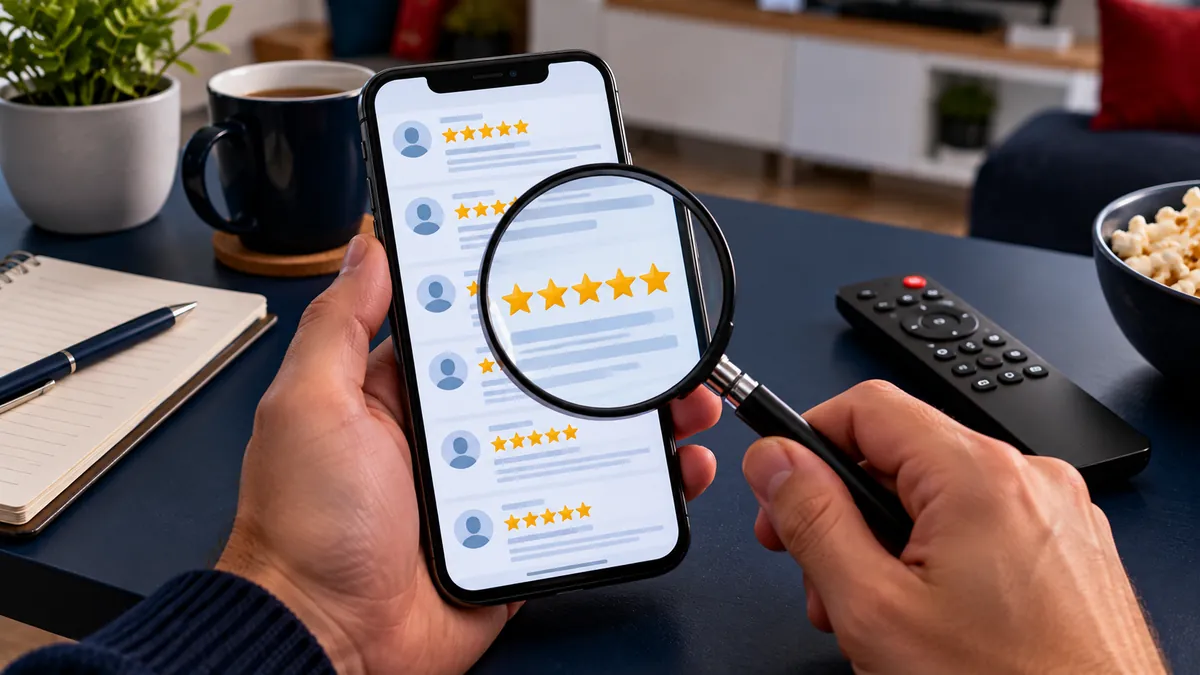
- Vague praise such as "best service ever, highly recommend" with no device, channel type or problem mentioned.
- New reviewer profiles with one review, or profiles that only review IPTV companies.
- Copied or very similar wording across several reviews, sometimes with the same spelling mistakes.
- Perfect scores only. Real services collect some three- and four-star reviews; a wall of fives is suspicious.
- The company name repeated unnaturally, as if written for search engines.
- No negative reviews answered, or every complaint answered with the same template.
- "Best IPTV" ranking sites where every list links to one seller, or where the reviewer cannot have tested the services.
- YouTube or TikTok videos with an affiliate link and a discount code, presented as an honest review.
- Reviews that mention things the service cannot do, such as features or prices the provider does not list.
One sign alone proves little; three or four together on the same page is a strong hint that the score has been manufactured.
How do you read Trustpilot, Google and social media reviews?
Trustpilot flags some companies with a warning when it detects suspicious activity, and lets you filter reviews by date and rating. Read the newest one- and two-star reviews first: they show how the company behaves when things go wrong. Also check whether reviews are marked as "invited" or not.
Google reviews are easy to leave and easy to fake. Click on reviewers' names to see what else they have reviewed. Someone who has rated twenty IPTV services in a month is not a normal customer.
Facebook groups and Reddit are full of personal recommendations, many from sellers. Our article on what IPTV UK Reddit gets right and wrong explains how to read them, and the risks of buying through marketplaces and groups covers what happens when a recommended seller vanishes.
What does a genuine IPTV review usually mention?
Real customers write about their own setup, because that is what they experienced. A believable review usually contains at least two of these:
- The device: a Firestick model, a Samsung or LG TV, an Android box or a phone.
- A specific problem: buffering on one channel, a TV guide that would not load, a login that failed.
- How support handled it: how long the reply took and whether the fix worked.
- A date or a context: a particular match, the first week, a house move.
- Something less than perfect: a small complaint alongside the praise.
A review with none of these, just stars and superlatives, adds nothing to your decision, whether it is genuine or not.
What does UK law say about fake reviews?
Since 6 April 2025, the Digital Markets, Competition and Consumers Act 2024 (DMCC Act) makes it unlawful for businesses to write or commission fake reviews, to hide incentivised reviews, or to present reviews in a misleading way. The Competition and Markets Authority can now enforce this directly and fine businesses that break the rules.
So be wary of any seller that offers you a free month in exchange for five stars: it is asking you to help it break the law. Our guide to the legal side of IPTV in the UK covers the other questions buyers ask.
Is there a better check than reviews?
Yes: checking the provider directly. A trial on the TV you actually use, refund terms in writing, prices anyone can see and support that answers tell you more than any score, and our ten checks for choosing a provider puts them in order.
Golden Gate's notes on buying an IPTV subscription safely and their IPTV safety tips look at the same risks from a buyer's point of view. If a trial does buffer, the IPTV buffering fixes help you tell a weak service from a weak Wi-Fi signal before you write any review yourself.
How does IPTV United Kingdom handle reviews?
We do not buy reviews, swap free months for ratings or publish rankings that put ourselves first. IPTV United Kingdom only shows reviews that real customers have agreed to share, with their first name, town, device and the date we received them, and the reviews section on our home page stays hidden until we have genuine ones to show.
If you see a ranking that claims to have tested us this month, check its date and its links; the IPTV UK November 2026 update explains why monthly lists deserve a second look.
Frequently asked questions
How can I tell if IPTV reviews are fake?
Look for bursts of five-star reviews, vague wording, new reviewer profiles, copied phrases and no detailed complaints. Several of these together is a strong warning sign.
Are fake reviews illegal in the UK?
Yes. Since 6 April 2025, the DMCC Act 2024 bans businesses from writing or commissioning fake reviews and from hiding incentivised ones.
Can I trust Trustpilot reviews for IPTV?
Use them with care. Read the newest low-star reviews, check reviewer profiles and look for Trustpilot warnings on the page.
Are best IPTV ranking sites reliable?
Often not. Many rank services they have not tested and link to one seller for commission.
What does a genuine IPTV review usually mention?
The reviewer's device, a specific problem or feature, and how support responded. Real reviews often include a small complaint alongside the praise.